2K
FillerZN-130
Soft Finishing Filler
Ultra-flexible, creamy 2K finishing filler for large surfaces and thin fills. Sands very easily without clogging the paper, leaving a flawless base for primer.
View product
Industrial Chemical SolutionsPaint systems for automotive refinishing and industrial surfaces
Multi-purpose 2K polyester filler for dents and surface defects on steel, aluminium, galvanised steel and fibreglass; non-sagging, fast-drying and easy to sand.
Packaging
1 kg · 2 kg
ZN-110 Universal Polyester Filler is a two-component, general-purpose body filler developed for automotive refinishing and industrial surface repair. It adheres strongly to bare steel, aluminium, galvanised steel, fibreglass and sanded existing paintwork. Because it performs with the same reliability on different substrates, it is a consistent and dependable starting point for most day-to-day bodywork in the workshop.
Its thixotropic consistency allows it to be spread to the required thickness on vertical surfaces without sagging. Its high filling capacity covers deep dents and surface irregularities in fewer coats, while its pore-free texture provides a smooth base for primer. The fast-drying formula is ready for sanding in a short time, and because it shapes easily without clogging the abrasive paper, it saves both material and labour.
In a typical repair, the area shaped with ZN-110 is brought to its final form with a thin coat of ZN-130 Soft Finishing Filler where necessary. For holes, tears and very deep damage, a reinforced fill with ZN-120 Fibreglass Filler is recommended first. After sanding, the surface is sealed with ZN-210 4+1 Acrylic Primer Filler, mixed with ZN-410 2K Acrylic Primer Hardener and ZN-510 Acrylic Thinner, leaving it ready for the paint system.
Values are typical at 20 °C and 65% relative humidity. Please review the product's current Technical Data Sheet (TDS) before application.
| Components | 2K – polyester filler + BPO hardener paste |
|---|---|
| Mixing ratio | 100 : 2–3 (by weight); BPO hardener paste included in the pack |
| Pot life (20 °C) | 4–6 min |
| Ready to sand (20 °C) | 20–30 min |
| Ready to sand (short-wave IR) | 3–5 min |
| Recommended coat thickness | Max. 3 mm per coat |
| Recommended abrasives | P80–P120 for shaping, P180–P240 for finishing (dry) |
| Colour | Beige |
| Density | Approx. 1.8 g/cm³ |
| Application tool | Metal or plastic spreader |
Beige
Our technical team will send the Technical Data Sheet (TDS) and Safety Data Sheet (SDS) you request by email.
Drying times vary with temperature, humidity, film thickness and air circulation. Consult our technical team about special conditions.
The recommended application sequence for a professional result.
Remove paint, rust and dirt from the repair area. Sand the bare metal with P80 and feather the edges of the surrounding paint with P120–P150 to a smooth transition. Then clean the surface with ZN-530 Surface Cleaning Thinner to remove grease, silicone and dust.
Mix the filler with the BPO hardener paste supplied in the pack at 2–3% by weight on a clean, flat mixing board. To avoid air bubbles, do not whip the mixture; fold and press it until the colour is uniform.
Apply the first coat as a thin adhesion coat, pressing it firmly onto the surface, then build up the fill in successive coats. Do not exceed 3 mm per coat, and use the mix within its pot life of 4–6 min.
At 20 °C the filler is ready to sand after approx. 20–30 min; with short-wave IR this drops to 3–5 min. If the ambient and panel temperature is below 10 °C, curing slows down considerably.
Start shaping with P80–P120 and finish the surface with P180–P240. Polyester fillers can absorb moisture, so do not wet sand; use a guide coat to reveal any remaining unevenness.
If fine correction is needed, apply ZN-130 Soft Finishing Filler. Prime the cleaned surface with ZN-210 4+1 Acrylic Primer Filler or ZN-220 5+1 HS Acrylic Primer.
Zenova products tested in the same system as this product, which give the best results together with it.
Ultra-flexible, creamy 2K finishing filler for large surfaces and thin fills. Sands very easily without clogging the paper, leaving a flawless base for primer.
High-strength, glass-fibre-reinforced 2K structural filler. Ideal for deep dents, tears, small holes and repairs to GRP/fibreglass parts.
2K filler developed with special resins for maximum adhesion on galvanised and zinc-coated steel. Can also be used with confidence on aluminium and its alloys.
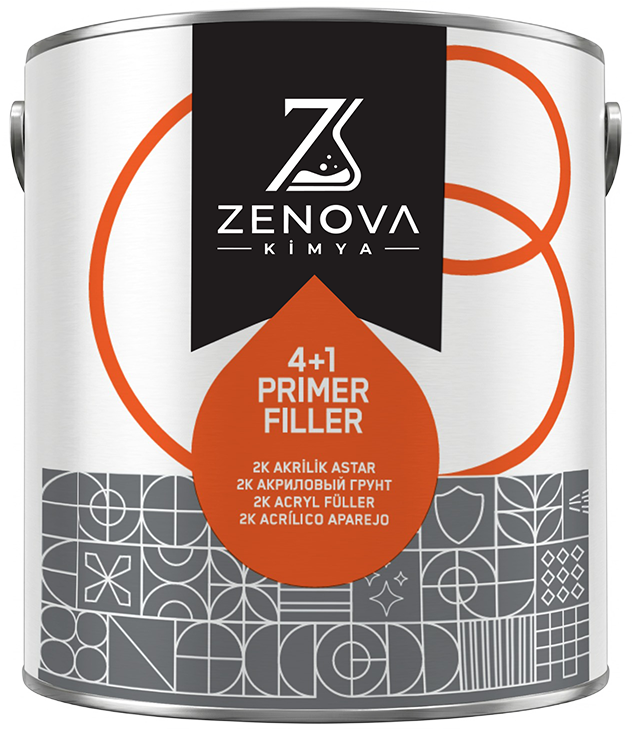
High-build 2K acrylic primer filler: covers filled areas, does not sag, sands easily and creates a smooth, isolating base for the topcoat.
Choosing the right abrasive from filler to clear coat: P grit grades, a typical sanding sequence, the 100-grit rule, dry vs wet sanding and orbital sanders.
Read articleSeven common critical mistakes in polyester filler application, with practical fixes for hardener dosage, mixing, layer thickness, sanding and pinholes.
Read articleAdd the product to your quote list or contact our sales team directly, and we will prepare a quote for the pack size and quantity you need.